

Operation Sindoor: IAF Chief Reveals Destruction of 10 Pakistani Jets, Dismisses Enemy Claims
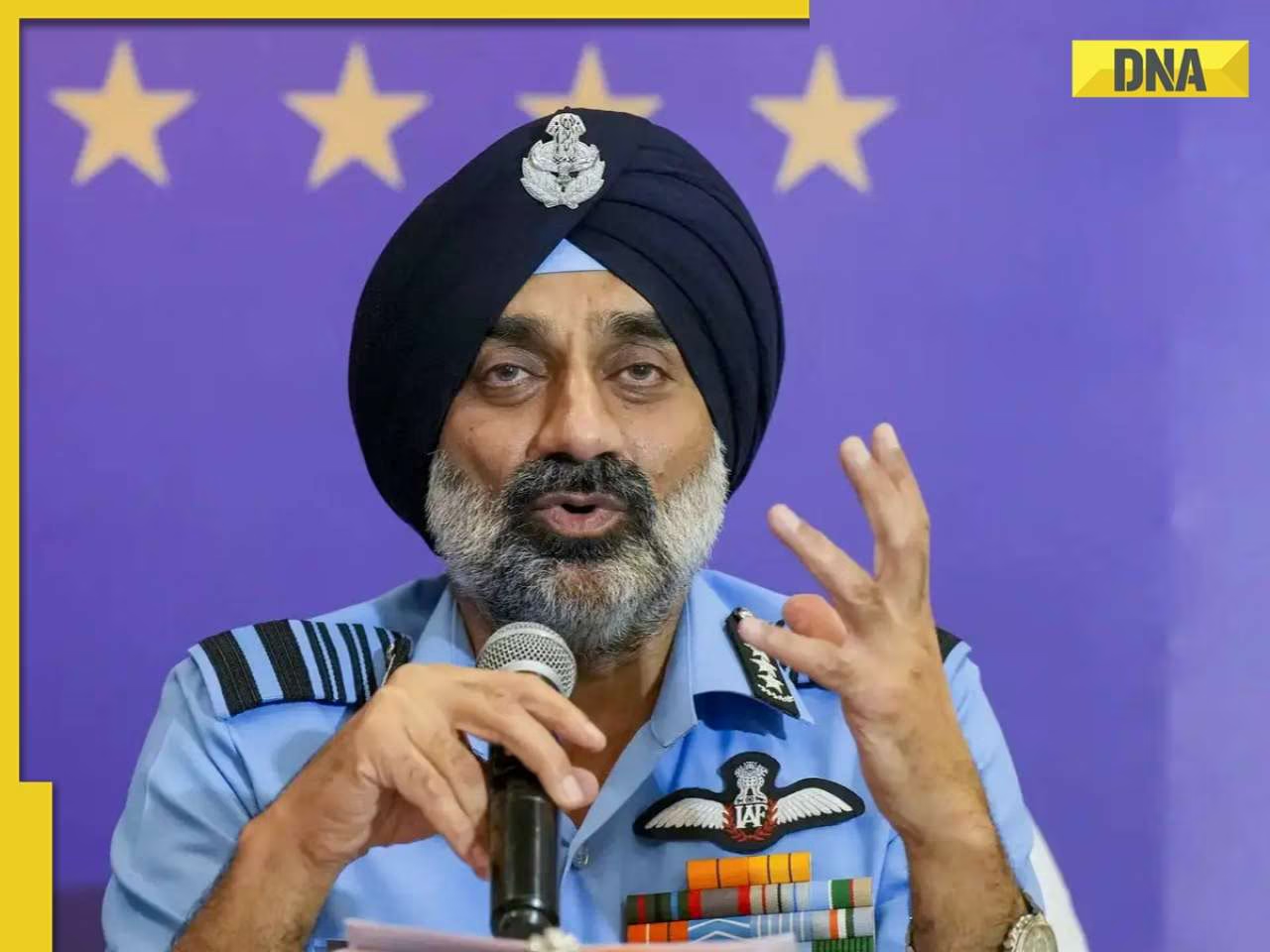
New Delhi, October 8 – Indian Air Force (IAF) chief Air Chief Marshal AP Singh made a major disclosure on Friday, revealing that the IAF destroyed between 8 and 10 Pakistani fighter aircraft, including US-made F-16s and Chinese JF-17s, during the May hostilities under Operation Sindoor. Speaking at the 93rd Air Force Day celebrations, the IAF chief described the operation as both a strategic and psychological blow to Pakistan, while dismissing Islamabad’s counterclaims as mere “manohar kahaniyan (fanciful tales).”
The Longest-Range Kill
For the first time, AP Singh provided a detailed account of the damage inflicted on Pakistan’s air power. He confirmed that India downed at least five fighter jets of the F-16 and JF-17 class, along with one advanced surveillance aircraft.
“We have clear evidence of a long-range strike, over 300 km deep into Pakistani territory, which took out either an AEW&C or a SIGINT aircraft. Along with that, five high-tech fighters between F-16 and JF-17 class were destroyed,” Singh stated.
Calling it the “highlight of the year” for the IAF, the Air Chief described the 300 km strike as the longest kill ever achieved by the force.
Heavy Losses on the Ground
The IAF chief also revealed that Pakistan suffered additional losses on the ground. Precision strikes by the Indian Air Force destroyed another four to five F-16s, along with several critical military assets.
The ground targets included:
-
Radars at four locations
-
Command and control centres at two bases
-
Two runways
-
Three hangars
-
One Surface-to-Air Missile (SAM) system
The operation, believed to have peaked on May 10, targeted as many as 11 military airbases inside Pakistan. According to Singh, this forced Islamabad into a corner, compelling it to request a ceasefire.
“We made Pakistan reach a stage where they had to ask for a ceasefire,” Singh said, underlining the effectiveness of India’s response.
Operation Sindoor: A Response to Pahalgam Attack
Operation Sindoor was launched just after midnight on May 7, in retaliation to the April 22 Pahalgam terror attack that claimed 26 lives. The mission focused on eliminating nine key terror camps inside Pakistani territory, while simultaneously neutralising its air power to prevent escalation.
Mocking Pakistan’s Claims
The IAF chief’s remarks also served as a direct rebuttal to Pakistani Prime Minister Shehbaz Sharif, who recently claimed at the UN General Assembly (UNGA) that Pakistan had shot down seven Indian jets.AP Singh dismissed the statement with biting sarcasm.
“If they think they downed our 15 jets, I hope they are convinced about it and will cater for 15 fewer aircraft in my inventory when they come to fight again,” he quipped.
He emphasised that Pakistan had produced no evidence to support its claims, whereas India’s post-strike assessments clearly documented Islamabad’s losses.
Strategic Significance
The revelation underscores India’s growing capability for precision, long-range operations and signals the Air Force’s readiness to deliver decisive responses. Analysts say the destruction of Pakistani aircraft and assets has not only crippled its air capability temporarily but also delivered a strong psychological blow, reshaping the balance of deterrence in the region.


