


Supermoon Secrets: Why the Moon Looked Closer but Really Wasn’t
Last night, many skywatchers around the world were mesmerized by a glowing, oversized Moon lighting up the horizon. It appeared unusually big and bright — almost as if it had drifted closer to Earth overnight. But despite appearances, the Moon never truly left its orbit. What you saw was a blend of astronomy and illusion.
The Science Behind the Supermoon
A supermoon occurs when the Moon reaches its closest point to Earth in its elliptical orbit, known as perigee, and simultaneously becomes full. This rare alignment makes the Moon appear up to 7% larger and 15–30% brighter than when it’s at its farthest point (apogee).
These changes are real and measurable — the Moon is physically a bit closer during perigee. However, the dramatic size difference your eyes perceive, especially when the Moon is near the horizon, is largely the work of your brain.
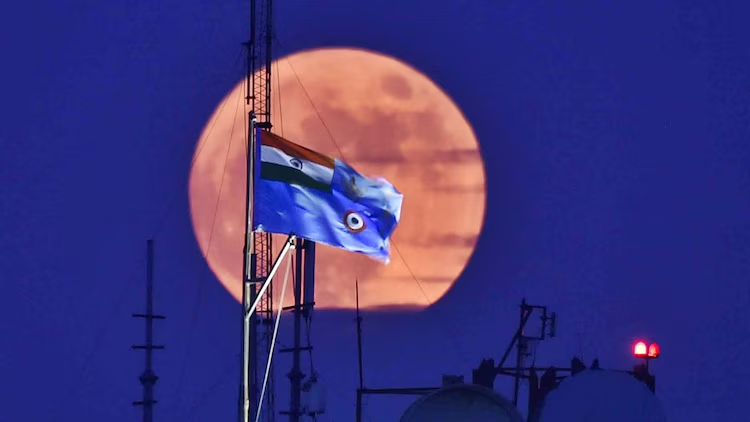
The Moon Illusion: When Your Mind Plays Tricks
This striking perception is known as the Moon illusion, a psychological and optical phenomenon that makes the Moon appear much larger when seen near the horizon compared to when it’s high in the sky.
In reality, photographs show that the Moon’s angular diameter — its actual size in the sky — remains constant. The illusion occurs because of how our brain interprets depth and distance. When the Moon rises behind buildings, trees, or mountains, the brain perceives it as farther away. To compensate for this perceived distance, it enlarges the Moon’s apparent size.
This same effect is similar to the Ponzo illusion, where converging lines — such as train tracks — make objects near the horizon appear larger or farther than they really are.
Test It Yourself
There’s an easy way to prove it’s just an illusion:
Hold a small object, like a coin or pebble, at arm’s length and use it to cover the Moon when it’s low on the horizon. Then do the same when the Moon is high in the sky. You’ll find the object covers the same area both times — showing that the Moon hasn’t changed size at all.
A Dance of Light and Perception
The combined effects of the supermoon’s actual proximity and the Moon illusion create one of nature’s most breathtaking visual displays — a perfect example of how science and perception intertwine.
So, while the Moon may have seemed to draw closer last night, it was really your mind — not the cosmos — doing the moving.
And if you missed the show, don’t worry — the next supermoon will bring another chance to be dazzled by this celestial trick of light and illusion.


