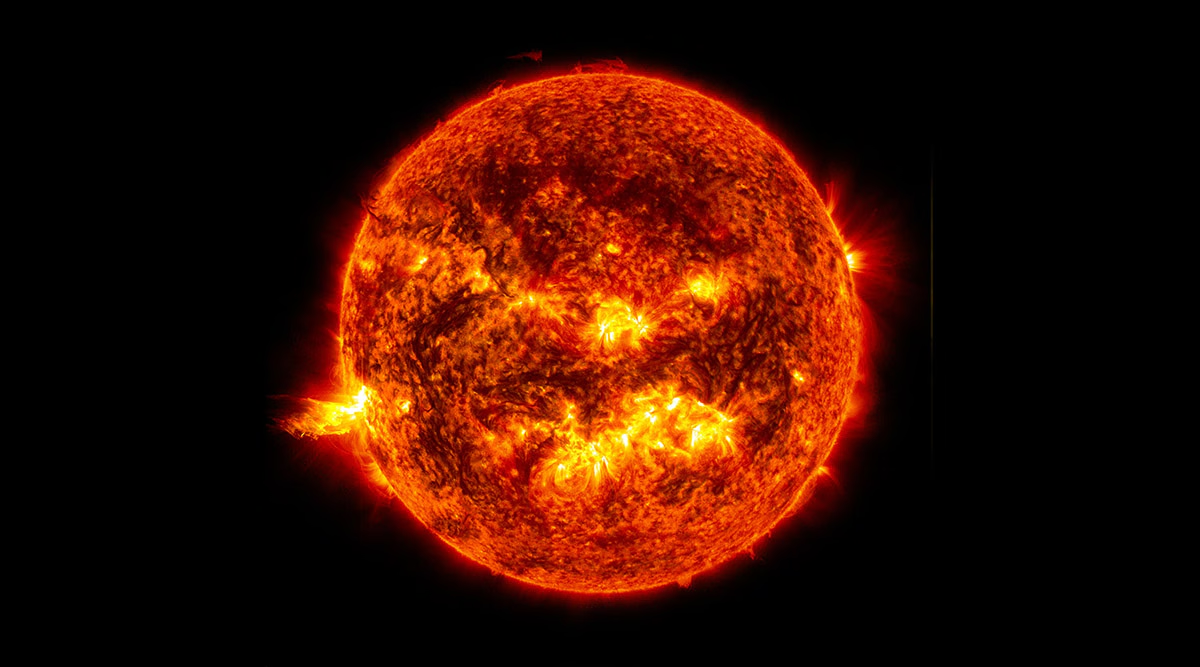
Scientists Finally Solve 80-Year Solar Mystery: Why the Sun’s Outer Layer Burns Hotter Than Its Surface
In a groundbreaking discovery, scientists have finally unlocked one of astronomy’s oldest mysteries — why the Sun’s outer atmosphere, or corona, burns millions of degrees hotter than its surface.
The breakthrough, published in Nature Astronomy, reveals the first-ever direct observation of tiny, twisting magnetic waves known as torsional Alfvén waves in the Sun’s corona — waves that have eluded scientists for over 80 years.
Using the world’s most powerful solar telescope, the Daniel K. Inouye Solar Telescope (DKIST) in Hawaii, researchers were able to capture these subtle magnetic ripples in unprecedented detail. The finding could explain how energy travels from the Sun’s surface into its outer layers, heating the corona to temperatures up to 1.6 million°C, despite the solar surface being only about 5,500°C.
Named after Nobel Prize-winning physicist Hannes Alfvén, these waves are magnetic disturbances that move through the Sun’s plasma — the superheated, electrically charged gas that forms the bulk of the solar atmosphere. While larger, explosive versions of these waves linked to solar flares have been detected before, this is the first direct evidence of their smaller, ever-present counterparts that may be continuously transferring energy upward.
The research, led by Professor Richard Morton of Northumbria University, utilised DKIST’s Cryogenic Near-Infrared Spectropolarimeter (Cryo-NIRSP) to detect delicate twisting motions within the corona’s turbulent plasma. By analysing highly ionised iron at extreme temperatures, the team observed minute Doppler shifts — alternating red and blue patterns — revealing the twisting motion caused by Alfvén waves.
Professor Morton’s team also developed new analytical methods to filter out dominant “kink” waves, which often conceal the torsional signals. The discovery confirms that these small-scale waves could be the missing piece in the long-standing “coronal heating problem” — explaining how the outer atmosphere becomes hotter than the Sun’s surface and helping identify one of the key drivers of the solar wind that streams through the solar system.
An international collaboration involving scientists from the UK, US, China, and Belgium, the study marks a new era in high-resolution solar research. The insights will significantly refine space weather forecasting, improving our ability to predict solar storms that can disrupt satellites, GPS, and even power grids on Earth.
“This is a huge step forward,” Professor Morton said. “We are finally seeing the Sun’s invisible heartbeat — the twisting magnetic waves that have been heating and energising its atmosphere all along.”
With DKIST paving the way, scientists say this discovery opens the door to deeper understanding of how magnetic forces shape not just our Sun, but stars across the universe.