Modi’s Big Bet on the Middle Class: GST 2.0 and the New Growth Strategy
After providing significant income tax relief earlier this year, the Modi government has now rolled out GST 2.0, a rate rationalisation move designed to put more money into the hands of Indian consumers. The strategy signals a major policy shift: instead of depending on big corporates to fuel economic growth, Prime Minister Narendra Modi is betting on the middle class—the backbone of India’s consumption-driven economy.
From Corporates to Consumers
In his third term as Prime Minister, Modi is not just asking for faith from the people; he is reciprocating by entrusting them with India’s growth story. Both the income tax relief and the new GST reforms aim to increase disposable income among households, thereby boosting demand.
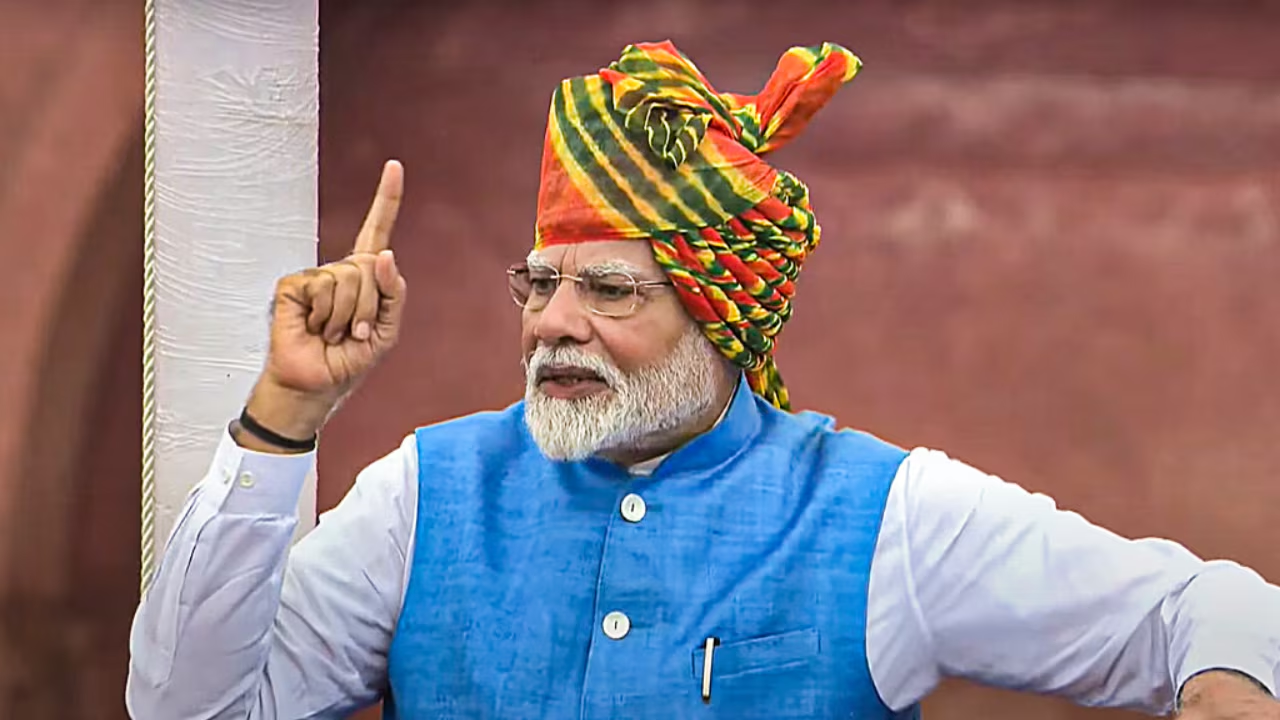
“GST Bachat Utsav,” Modi announced in his address to the nation, will begin on September 22. The festival of savings, he explained, is expected to benefit the poor, the neo-middle class, and the middle class alike. Together with the earlier tax concessions, the twin measures are projected to help citizens save over ₹2.5 lakh crore annually.
This new faith in consumers comes after a disappointing experiment with corporates. Back in 2019, the government slashed corporate tax rates from 30% to 22%, hoping businesses would reinvest their savings into expansion, job creation, and higher wages. However, despite reporting profits at a 15-year high, corporates largely pocketed the gains without boosting real wages or triggering broad-based growth.
The government ended up losing ₹1.84 lakh crore in revenue in just two years (2019–21), while corporate tax collections fell behind individual income tax receipts for the first time. In 2023–24, personal income tax collections touched ₹10.44 lakh crore, compared to ₹9.11 lakh crore from corporates.
Why the Middle Class Matters
Economic strategists suggest this pivot was inevitable. “The government tried to boost demand indirectly through corporates, but it didn’t work. Now, it is injecting cash directly into the people’s hands. After direct tax relief, we now have indirect tax relief,” says political strategist Amitabh Tiwari.
According to Tiwari, the GST rate rationalisation may cost the exchequer around ₹48,000 crore annually, but much of this will circle back. As consumption rises, GST collections are expected to recoup about 10% of the shortfall.
Private consumption already accounts for 61.4% of India’s nominal GDP (2024–25). Strengthening consumer demand, therefore, is not only logical but essential if India is to achieve its long-term growth ambitions.
The Rise of the Neo-Middle Class
Modi has consistently highlighted the importance of the neo-middle class—a group that has recently risen out of poverty and now harbors new aspirations. Over 25 crore people have moved above the poverty line in recent years, forming a growing cohort of consumers whose spending power will increasingly shape India’s economic trajectory.
“Our poor, middle class, neo-middle class, youth, farmers, women, shopkeepers, traders, entrepreneurs—all will benefit from this savings festival,” Modi declared in his Sunday speech. For him, nurturing this consumer base is as much about economic policy as it is about social transformation.
Looking Ahead: Viksit Bharat 2047
The Prime Minister has set the ambitious target of making India a developed nation by 2047, which will require annual GDP growth of at least 8%. That vision, he now believes, rests less on corporate boardrooms and more on the wallets of everyday Indians.
The GST Bachat Mahotsav, beginning today, is more than just a tax reform—it is a symbol of the government’s vote of confidence in the middle class. By empowering ordinary citizens, Modi hopes to ignite the consumption engine and steer India closer to its goal of becoming a global economic powerhouse.