
Untitle MediaUntitle Media
  • Entertainment
  • Science
  • Health
  • Politics
  • Travel
    • Beautiful
    • Destinations
    • Discover
    • Followme
    • Vacation
  • Business
    • Cryptocurrency
    • Investment
    • Branding
    • Marketing
    • Startup
  • Technology
    • Computer
    • Electronics
    • Innovation
    • Smartphone
    • Software
  • Post SubmissionFREE
  • Member
    • Join Us
    • Login
Reading: “Why Modi’s Economic Focus Has Moved From Corporates to Middle Class”
Aa
Untitle MediaUntitle Media
Aa
Follow US
Untitle Media > Blog > Politics > “Why Modi’s Economic Focus Has Moved From Corporates to Middle Class”
Politics

“Why Modi’s Economic Focus Has Moved From Corporates to Middle Class”

Aimee
Posted Aimee
Updated 2025/09/22
Share
6 Min Read

Modi’s Big Bet on the Middle Class: GST 2.0 and the New Growth Strategy


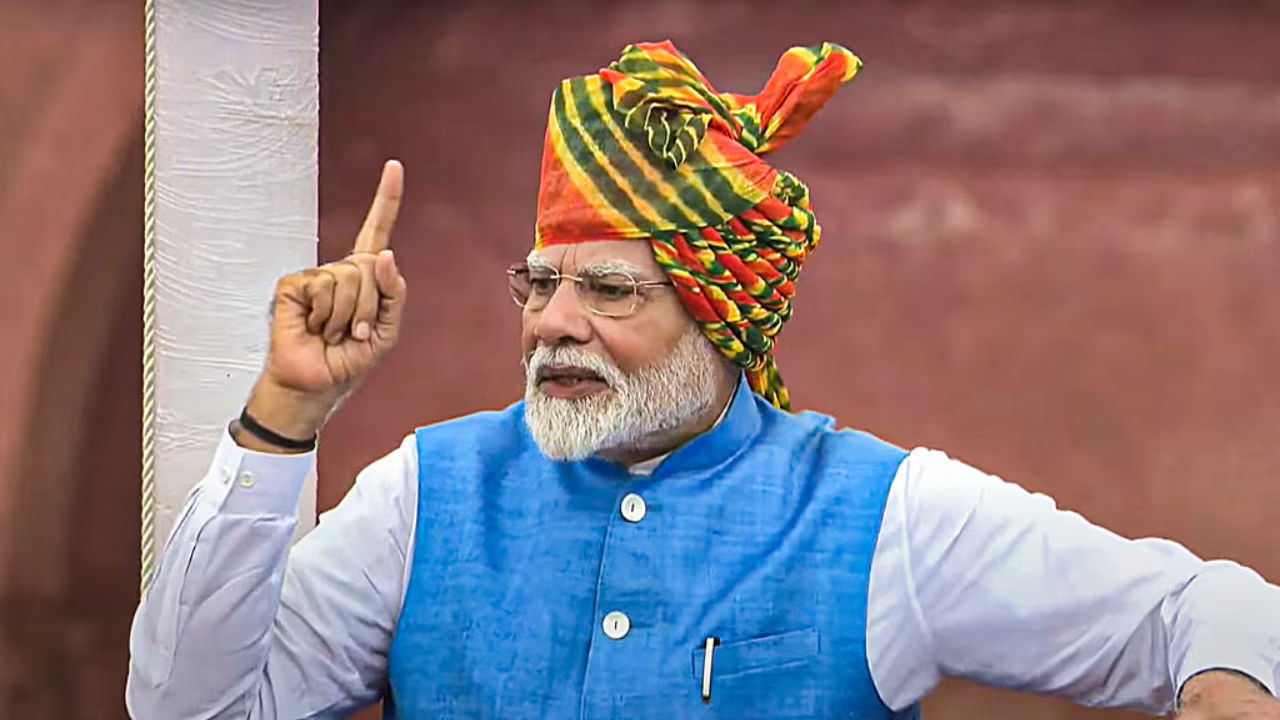
After providing significant income tax relief earlier this year, the Modi government has now rolled out GST 2.0, a rate rationalisation move designed to put more money into the hands of Indian consumers. The strategy signals a major policy shift: instead of depending on big corporates to fuel economic growth, Prime Minister Narendra Modi is betting on the middle class—the backbone of India’s consumption-driven economy.


From Corporates to Consumers


In his third term as Prime Minister, Modi is not just asking for faith from the people; he is reciprocating by entrusting them with India’s growth story. Both the income tax relief and the new GST reforms aim to increase disposable income among households, thereby boosting demand.


“GST Bachat Utsav,” Modi announced in his address to the nation, will begin on September 22. The festival of savings, he explained, is expected to benefit the poor, the neo-middle class, and the middle class alike. Together with the earlier tax concessions, the twin measures are projected to help citizens save over ₹2.5 lakh crore annually.


This new faith in consumers comes after a disappointing experiment with corporates. Back in 2019, the government slashed corporate tax rates from 30% to 22%, hoping businesses would reinvest their savings into expansion, job creation, and higher wages. However, despite reporting profits at a 15-year high, corporates largely pocketed the gains without boosting real wages or triggering broad-based growth.

The government ended up losing ₹1.84 lakh crore in revenue in just two years (2019–21), while corporate tax collections fell behind individual income tax receipts for the first time. In 2023–24, personal income tax collections touched ₹10.44 lakh crore, compared to ₹9.11 lakh crore from corporates.


Why the Middle Class Matters


Economic strategists suggest this pivot was inevitable. “The government tried to boost demand indirectly through corporates, but it didn’t work. Now, it is injecting cash directly into the people’s hands. After direct tax relief, we now have indirect tax relief,” says political strategist Amitabh Tiwari.


According to Tiwari, the GST rate rationalisation may cost the exchequer around ₹48,000 crore annually, but much of this will circle back. As consumption rises, GST collections are expected to recoup about 10% of the shortfall.


Private consumption already accounts for 61.4% of India’s nominal GDP (2024–25). Strengthening consumer demand, therefore, is not only logical but essential if India is to achieve its long-term growth ambitions.


The Rise of the Neo-Middle Class


Modi has consistently highlighted the importance of the neo-middle class—a group that has recently risen out of poverty and now harbors new aspirations. Over 25 crore people have moved above the poverty line in recent years, forming a growing cohort of consumers whose spending power will increasingly shape India’s economic trajectory.


“Our poor, middle class, neo-middle class, youth, farmers, women, shopkeepers, traders, entrepreneurs—all will benefit from this savings festival,” Modi declared in his Sunday speech. For him, nurturing this consumer base is as much about economic policy as it is about social transformation.


Looking Ahead: Viksit Bharat 2047


The Prime Minister has set the ambitious target of making India a developed nation by 2047, which will require annual GDP growth of at least 8%. That vision, he now believes, rests less on corporate boardrooms and more on the wallets of everyday Indians.


The GST Bachat Mahotsav, beginning today, is more than just a tax reform—it is a symbol of the government’s vote of confidence in the middle class. By empowering ordinary citizens, Modi hopes to ignite the consumption engine and steer India closer to its goal of becoming a global economic powerhouse.

Aimee September 22, 2025
Share this Article
Facebook Twitter Whatsapp Whatsapp LinkedIn Telegram Email
Leave a review Leave a review

Leave a review Click here to cancel reply.

Please select a rating!

This site uses Akismet to reduce spam. Learn how your comment data is processed.

Popular Posts

Ketan Agarwal Murder Case
Love, Lies and Death at Lohagad Fort: Fiancée and Secret Lover Turn Against Each Other in Ketan Agarwal Murder Case
India News
Lucknow Blaze Horror
Lucknow Blaze Horror: Trapped Students Made Final Pleas For Help As 15 Died
India News
Lohagad Fort Murder Plot
Hoodie Clue Helps Police Uncover Alleged Lohagad Fort Murder Plot
India News
Family Of Mumbai Local Train Murder Victim Demands Death Penalty
India News
Mumbai School Bus Tragedy Claims Young Life
Mumbai Boy Cremated With Beloved Cricket Bat After School Bus Tragedy
India News
Ram Mandir Donation Theft Case: Accused Allegedly Reveals How Cash Was Hidden Inside Temple
India News

RecenyPosts

Dharmendra Pradhan Targets Rahul Gandhi Over NEET Protest, Says Congress Chose Politics Over Student Solutions
India News Politics
Gautami Kapoor Defends Ram Kapoor After Shreya Kalra's Allegations
Gautami Kapoor Defends Ram Kapoor After Shreya Kalra’s Allegations Spark Online Debate
Entertainment
Sonam Wangchuk Sets 3 Conditions to End Hunger Strike
Sonam Wangchuk Sets 3 Conditions to End Hunger Strike as Parliament March Puts Pressure on Centre
India News
RBI Plans Plastic Currency Notes:
RBI Plans Plastic Currency Notes: India May Soon Get Rs 10 and Rs 20 Polymer Banknotes
Business Finance India News
Sonam Wangchuk Health Worsens as Hunger Strike Enters Day 20
Sonam Wangchuk Health Worsens as Hunger Strike Enters Day 20, Doctors Warn of Organ Failure
India News
Indian Muslim Stabbed 15 Times In Utah Mall
Indian Muslim Stabbed 15 Times In Utah Mall After Religion Question, Hate Crime Probe Underway
India News

You Might Also Like

Dharmendra Pradhan Targets Rahul Gandhi Over NEET Protest, Says Congress Chose Politics Over Student Solutions

July 22, 2026
Shinde Meets UBT MPs In Delhi
India NewsPolitics

Operation Tiger Buzz Grows As UBT MPs Meet Eknath Shinde

June 17, 2026
19 MPs Move to Split Mamata’s TMC
India NewsPolitics

High Stakes Rebellion: 19 Rebel MPs Seek to Split Mamata Banerjee’s TMC in Lok Sabha

June 12, 2026
Karnataka Congress CM change buzz grows
India NewsPolitics

Congress Power Clash In Karnataka Sparks CM Change Buzz

May 28, 2026
Untitle Media

UNTITLE MEDIA provides media production and marketing services to local businesses and entrepreneurs helping them utilize online tools to grow their business and brand.

Facebook Like
Instagram Follow
  • Business
  • Branding
  • Cryptocurrency
  • Investment
  • Marketing
  • Startup
  • Entertainment
  • Fashion
  • Technology
  • Computer
  • Electronics
  • Innovation
  • Smartphone
  • Software
  • Travel
  • Destinations
  • Health
  • Politics
  • Science
  • Discover
  • Follow me
  • Vacation
  • World news

2024 © Untitle Media. All Rights Reserved.

  • Write for Us
  • FAQ’s
  • Contact Us
  • Privacy Policy
  • Terms of Use

Removed from reading list

Undo
Untitle Media Untitle Media
Welcome Back!

Sign in to your account

Lost your password?