


IIT Bombay Students Clarify Stand on Protest
IIT Bombay student representatives have clarified that their three-day campus protest following the death by suicide of second-year student Sahil Wakode was not intended to justify cheating or academic misconduct.
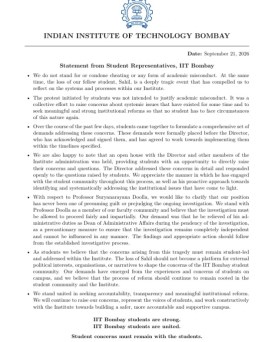
In an official statement issued on September 21, the students said they did not condone cheating in any form. They said Sahil’s death, however, had prompted them to examine institutional systems, processes and concerns around student welfare and accountability.
The clarification came hours after IIT Bombay removed Professor Suryanarayana Doolla from his position as Dean of Administrative Affairs. The institute said Doolla would continue as a professor while an investigation into the circumstances surrounding Sahil’s death proceeds.
Protest Focused on Systemic Concerns
Sahil died by suicide on September 18 after an incident during an examination earlier that day. IIT Bombay had initially stated that he was found using a mobile phone during the examination and had uploaded the question paper to ChatGPT to seek answers.
The institute had said Sahil was counselled following the incident and that no disciplinary action had been initiated against him.
His death subsequently triggered protests on campus, with students raising concerns about the institute’s handling of the incident as well as broader issues involving student welfare, mental-health support, representation and institutional accountability.
In their latest statement, the student representatives stressed that the protest was about these systemic concerns and not about defending academic misconduct.
The students said they had formulated a set of demands over the previous few days and formally presented them to IIT Bombay Director Shireesh Kedare. According to the representatives, the Director acknowledged and signed the demands and agreed to work towards their implementation within specified timelines.
Students Address Doolla Controversy
The student representatives also clarified their position regarding Professor Suryanarayana Doolla, who was the invigilator during the examination in which Sahil was allegedly found with a phone.
The students said they had never presumed Doolla’s guilt or sought to prejudge the ongoing investigation. They said they stood with him as a member of the faculty community and wanted the investigation to proceed fairly and impartially.
The students said their demand was for Doolla to be relieved of his administrative responsibilities as Dean during the investigation. They described this as a precautionary step intended to ensure the independence of the probe.
IIT Bombay subsequently removed Doolla from the deanship with immediate effect and said he would continue as a professor. The institute also apologised for aspects of its earlier communication about Sahil’s death, saying details of the incident remained under investigation.
Sahil’s Family Raises Caste Discrimination Allegations
The case has also included allegations of caste-based discrimination. Sahil’s parents have alleged that he faced caste-based discrimination and harassment on campus.
IIT Bombay has said that no complaint regarding caste discrimination had been submitted by Sahil to its SC-ST cell or the administration.
Based on a complaint filed by Sahil’s father, Mumbai Police registered an FIR naming Doolla. The case invokes Section 108 of the Bharatiya Nyaya Sanhita, relating to abetment of suicide, along with provisions of the Scheduled Castes and Scheduled Tribes (Prevention of Atrocities) Act. According to the source, the investigation has been transferred to the Crime Branch.
The allegations remain subject to investigation.
Students Call for Student-Led Reform
The representatives also said concerns arising from Sahil’s death should remain student-led and should be addressed within IIT Bombay.
They opposed attempts to allow external political interests, organisations or narratives to shape the concerns of the student community.
The students said their demands emerged from experiences within the institute and that the reform process should remain rooted in the student community.
They concluded that students remained united in seeking accountability, transparency and institutional reform, with the aim of creating a safer and more supportive campus environment.


